
Compas Cartagena Terminal Employs LHM 600 Crane
Jun 16, 2026
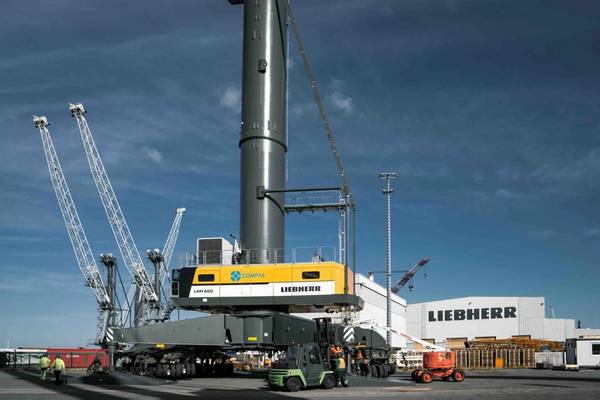
Shown here at Liebherr’s Rostock production site shortly before departure, the LHM 600 was manufactured at the company’s Baltic headquarters before being shipped to Colombia for deployment at Compas’ Cartagena terminal. © Liebherr
Compas has placed an LHM 600 into service at its Cartagena terminal to reinforce container-handling capability within one of the country's most active maritime zones. The crane's 61-meter outreach allows it to work across wider container vessels calling at the terminal, while its 104-ton lifting capacity supports heavy container moves and twin-lift operations where required. Mounted on a mobile undercarriage, the crane can be reallocated between berths as traffic patterns change. This flexibility is particularly relevant at a multipurpose terminal handling containers alongside bulk, project and refrigerated cargo.
Located in one of Colombia's most strategically positioned port areas, Compas Cartagena functions as a connection point between domestic supply chains and international shipping routes. The terminal combines container operations with bulk and general cargo handling, supported by specialized infrastructure including certified cold storage facilities and non-intrusive inspection systems capable of scanning up to 150 containers per hour. Introducing higher-capacity quay handling equipment helps balance these diverse operational requirements without compromising throughput or safety.
The arrival of the crane also supports smoother vessel turnaround during peak periods, reducing operational bottlenecks and supporting consistent cargo flows through the Colombian Caribbean.
At Compas Cartagena, where four berths support container, bulk, refrigerated and project cargo alongside one another, operational sequencing is critical. The LHM 600 adds an additional layer of planning certainty by allowing higher-capacity container moves to be scheduled without disrupting parallel cargo flows. This supports more consistent berth utilisztion and aligns crane performance with the terminal's digital operating systems and inspection infrastructure.
The crane is supported by Liebherr's regional sales and service organization, ensuring access to local technical expertise, spare parts and scheduled maintenance. This framework is designed to maintain predictable crane availability while supporting the terminal's continuous operations.
For Colombia, where ports serve not only as trade gateways but as economic stabilizers for regional industries, incremental improvements at established terminals often deliver the greatest long-term value.
crane
port
Colombia